
AI Focused Training
In the world of AI you need a trainer who has not just used AI but has successfully taught others how to use it.

AI Focused Rise Sample
This is an example of a training created using RISE. The course was built out of a need to have learners appreciate the reasoning behind using a public and internal AI system.
AI Focused Storyline
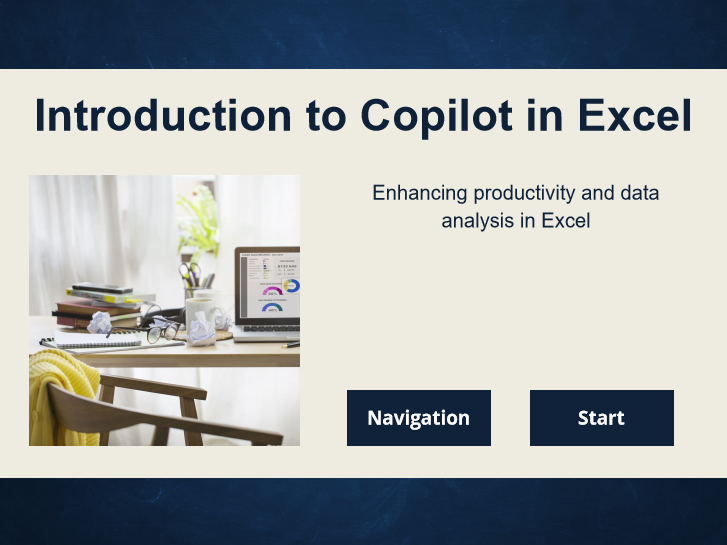
This is an example of a training created using Storyline. This sample utilized AI in order to teach Copilot and is a snippet from the final course.
AI ILT Course for Church Leaders
-
Title Slide (Slide 1)
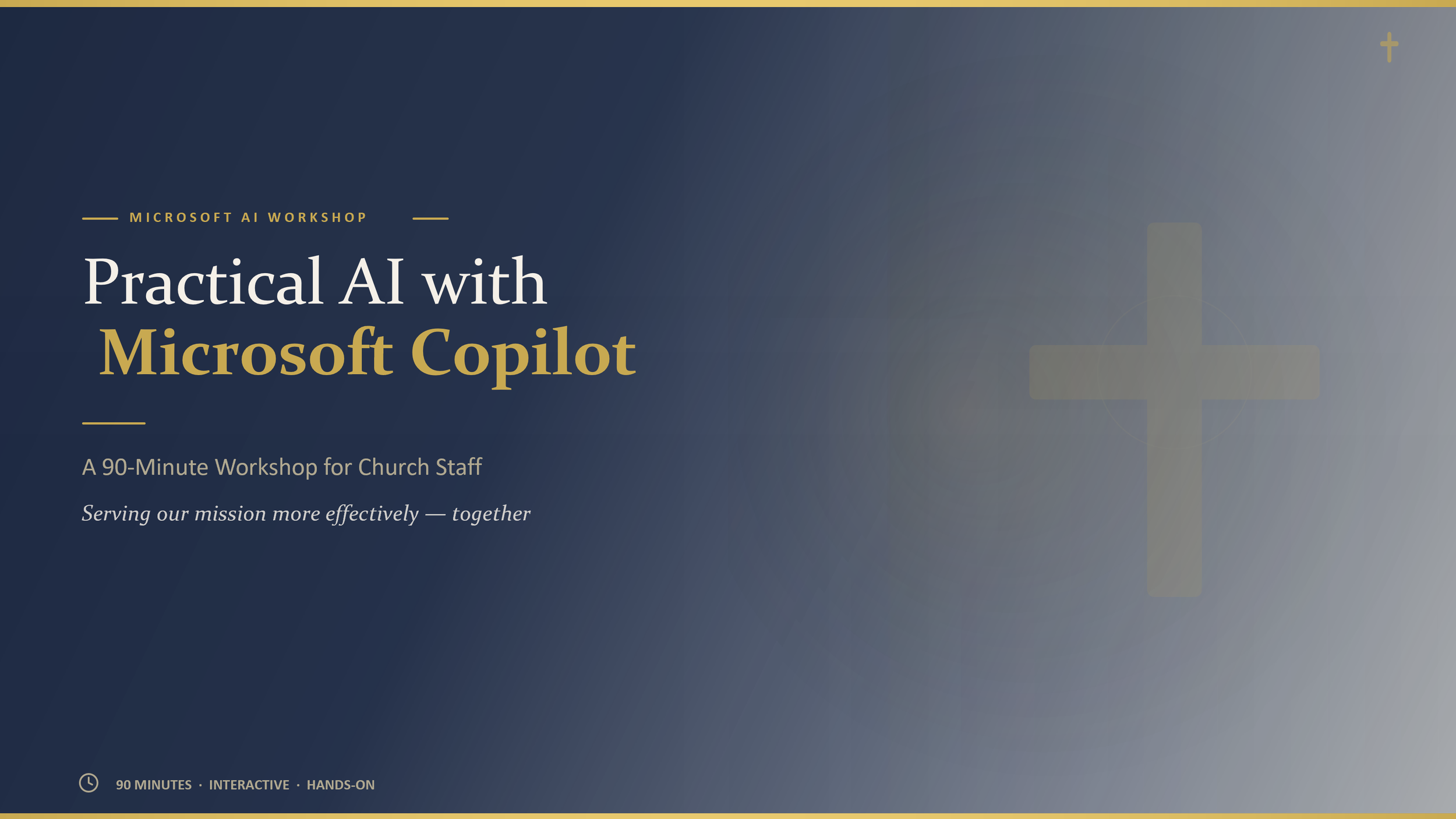
Welcome to Practical AI with Microsoft Copilot. In this session, we'll explore practical ways Microsoft Copilot can help church leaders save time, simplify administrative tasks, and spend more of their energy on ministry and serving others. Whether you're new to AI or have already experimented with it, this session is designed to provide practical examples, responsible guidance, and techniques you can begin using right away.
By the end of our 90 minutes together, you'll have a better understanding of what Microsoft Copilot is, what it can and cannot do, how to write effective prompts, and how to apply it to common ministry tasks such as communication, planning, meeting preparation, document creation, and other day-to-day responsibilities. You'll also learn best practices for using AI responsibly, ethically, and in ways that support—rather than replace—the uniquely human aspects of ministry.
-
Why now? Why Us? (Slide 4)
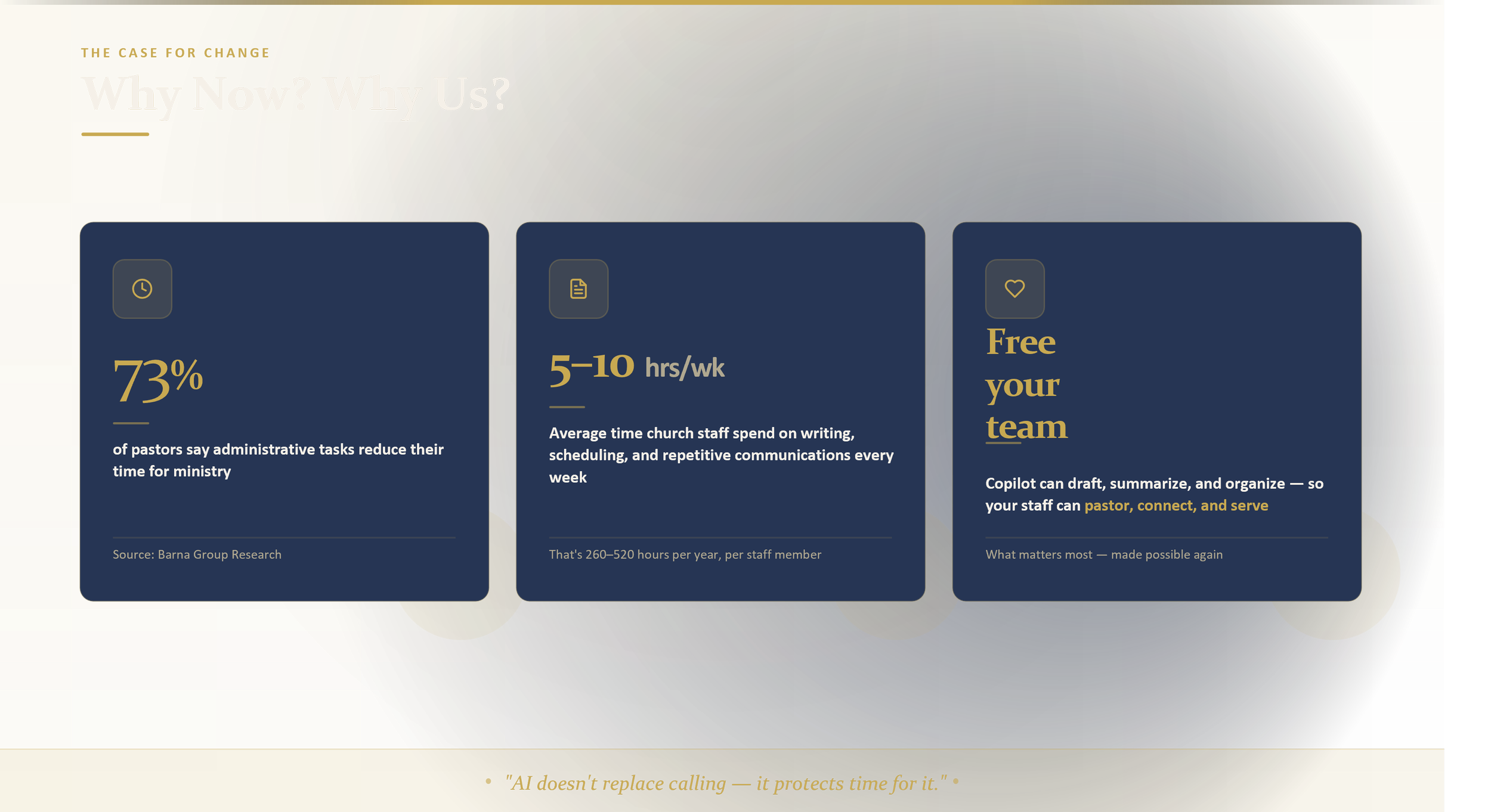
So why are we talking about AI in a church setting? Because this isn't really a technology conversation, it's a time conversation. Barna research found that 73% of pastors say administrative responsibilities reduce the time they can spend on ministry. Most church staff spend five to ten hours every week writing communications, scheduling activities, organizing information, and handling repetitive administrative work. Over the course of a year, that's 260 to 520 hours per person.
Imagine if even a portion of that time could be redirected toward people instead of paperwork. That's why we're here today. The goal isn't to replace ministry with technology. The goal is to use technology to create more space for ministry. More time for conversations. More time for discipleship. More time for serving others. AI helps make what matters most more possible.
-
Common Myths & Misconceptions (Slide 6)
Before we go any further, we need to clear some ground — because most of us came in here today carrying at least one story about AI that isn’t quite true.
Look at the card in front of you.
Each card has a myth on one side — something people commonly believe or worry about when it comes to AI — and the factual response on the other. Take 60 seconds and read through them.
Any of these land with you? Any surprises? Anything you’d push back on?
“Here is the frame I want us to hold for everything we do today — and honestly, for every time we use these tools going forward:
AI is a tool. A remarkable one. But a tool.
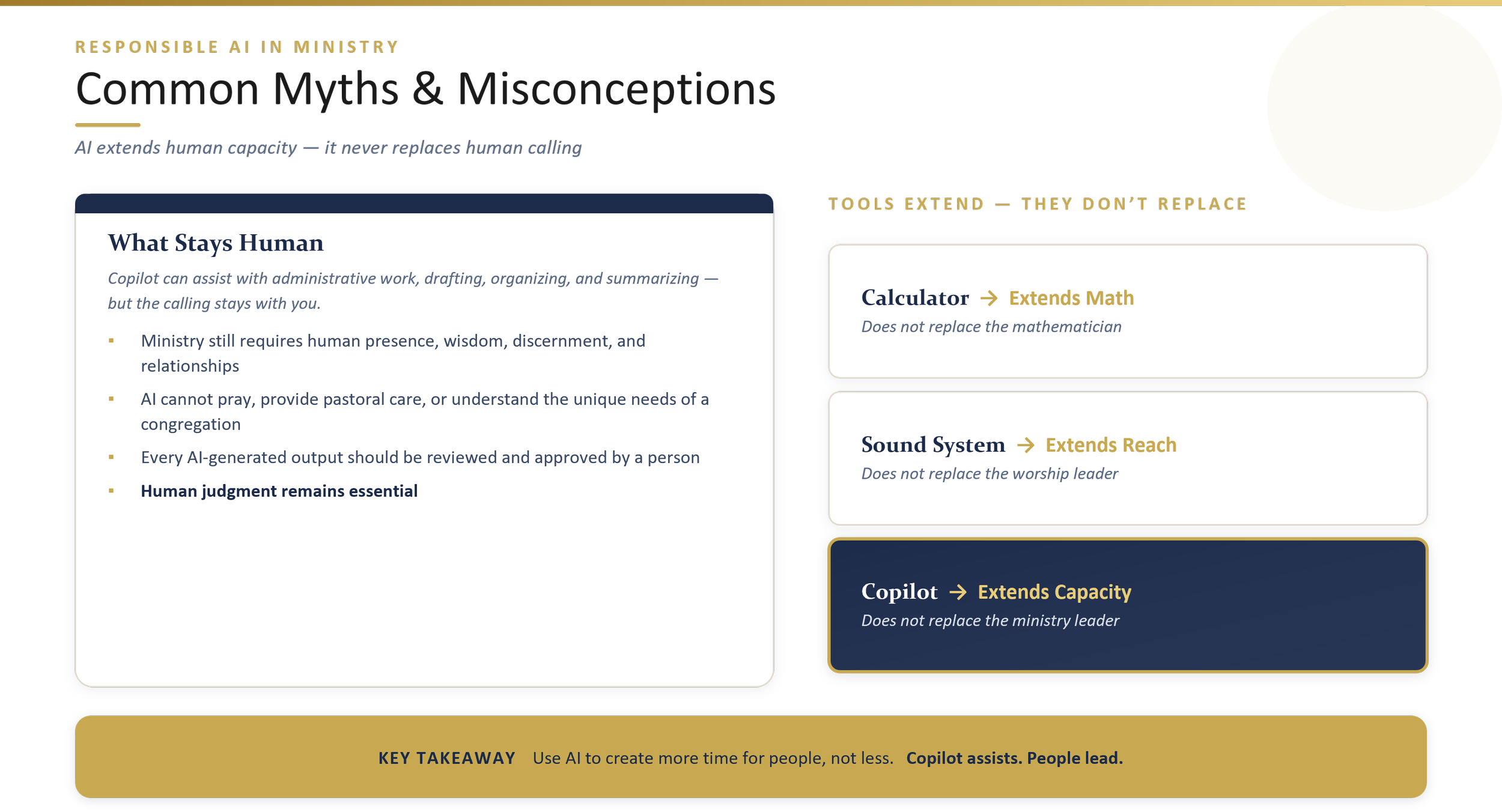
A calculator doesn’t make you less of a mathematician. A sound system doesn’t make you less of a worship leader. Copilot doesn’t make you less of a pastor, an administrator, or a communicator. It extends your capacity. It does not replace your calling.
This matters especially here, in ministry. No AI will sit with a grieving family. No AI will notice that a volunteer is quietly burning out. No AI will know that the best illustration for Sunday’s sermon is what happened in your own congregation last Thursday. Those things require a human being — with presence, discernment, and relationship. What Copilot can do is take 45 minutes of email drafting off your plate so you have more energy for those moments.
Every output this tool generates passes through a person on this team — someone who prays over the work, cares about the people receiving it, and takes responsibility for what goes out. That’s not a policy. That’s a commitment.
Copilot assists. People lead.
-
What am I Asking of AI?
Now that we know what AI is and what it isn’t, we need to talk about something that matters deeply for how we use it here: the difference between what AI is designed to do, and what it is not equipped to do.
AI is a powerful productivity tool. It can draft, organize, summarize, and suggest. But there is a category of work in ministry that falls entirely outside what AI should touch — and that category is spiritual discernment.
When we talk about AI for ministry administration, we mean the operational layer: communications, scheduling, document drafting, data summarization, note-taking. Tasks that have a right answer, a repeatable structure, or a clear deliverable.
These are exactly where AI earns its keep.
Spiritual discernment is something else entirely. It is the work of listening for God’s voice in a specific situation, with a specific person, with the weight of Scripture, prayer, and pastoral relationship behind every word. That is irreducibly human. It requires the Holy Spirit, lived experience, and covenantal trust with the people you serve. No AI output should ever substitute for that — not because AI isn’t clever, but because the person across from you deserves a human being, not a prediction engine.